



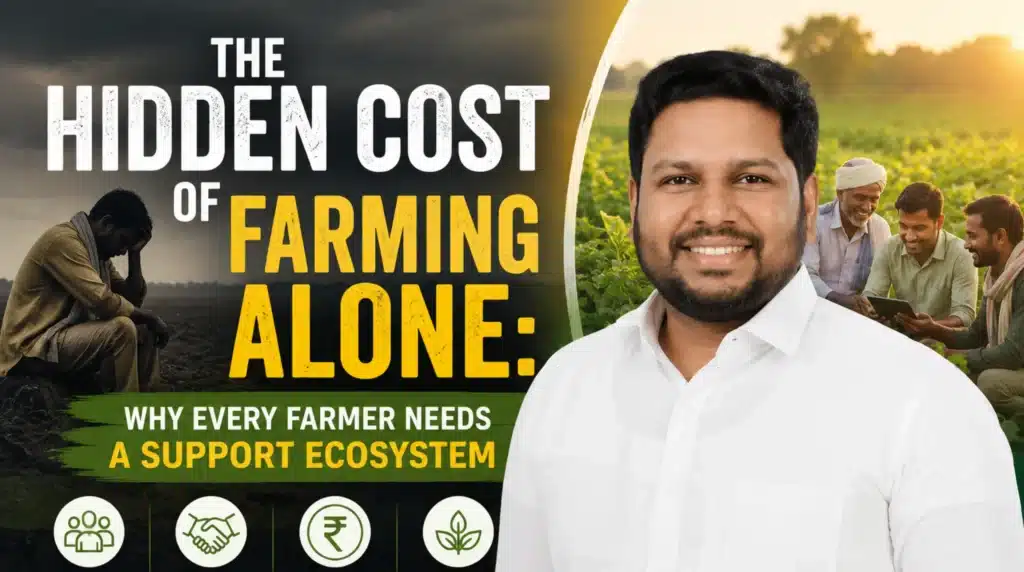
There is a strange expectation society places on farmers.
The moment someone decides to grow food, we somehow expect them to become experts in everything else too.
Not just farming.
Accounting.
Marketing.
Insurance.
Legal paperwork.
Government regulations.
Supply chain management.
Pricing.
Negotiation.
Risk management.
Somewhere along the way, farming stopped being just farming.
And nobody seems to be talking about it.
Imagine walking into a cricket stadium and telling the opening batsman that, apart from scoring runs, he also needs to act as the umpire, coach the team, maintain the pitch, sell the tickets, and provide live commentary during the match.
You would laugh at the absurdity of that idea.
Yet that is exactly how modern agriculture operates for millions of farmers.
We keep adding responsibilities to their shoulders and then wonder why so many are struggling.
The uncomfortable truth is that many farmers are not failing because they lack farming skills. They are struggling because they are being forced to manage an entire business ecosystem alone.
Growing crops is only one part of the job today.
Before a farmer can even think about harvesting, there are loans to manage, paperwork to complete, market prices to monitor, weather patterns to understand, insurance policies to navigate, government schemes to apply for, and buyers to negotiate with.
That’s a full-time workload by itself.
Now add the actual physical work of farming on top of it.
No wonder so many feel overwhelmed.
People often talk about self-sufficiency as if it is the ultimate goal. It sounds admirable. It sounds strong. It sounds independent.
But there is a difference between being self-sufficient and being isolated.
One creates resilience.
The other creates exhaustion.
Human beings have never succeeded alone.
Every successful business operates through networks of specialists. Every successful sports team relies on people performing different roles. Every successful industry is supported by systems, advisors, experts, and communities working together.
Agriculture should be no different.
The idea that one farmer should single-handedly manage production, finance, compliance, marketing, logistics, and risk management is not a sign of strength.
It is a design flaw.
This is precisely why farmer support services have become more important than ever.
Not because farmers are incapable.
But because modern agriculture has become too complex for any one person to handle alone.
The best support systems do something incredibly simple.
They allow farmers to focus on farming.
When financial experts help with loans, when advisors provide technical guidance, when insurance professionals assist with claims, and when market specialists help farmers access buyers, something remarkable happens.
Farmers make better decisions.
Not because they suddenly became smarter.
Because they finally have access to the right expertise at the right time.
That is the real value of agricultural assistance in India.
People often think assistance means handouts.
It doesn’t.
Real assistance means helping farmers navigate systems that have become increasingly difficult to understand.
It means reducing confusion.
It means providing access to information.
It means making sure a farmer spends less time fighting bureaucracy and more time improving productivity.
Most importantly, it means ensuring that farmers are not left to solve every problem alone.
There is another factor that often gets overlooked in these conversations.
Community.
For thousands of years, agriculture survived because knowledge was shared.
Farmers learned from one another.
They exchanged ideas, techniques, resources, and experience.
Problems that seemed impossible for one individual became manageable when a community tackled them together.
Somewhere along the way, many farming communities became increasingly isolated.
And isolation has a cost.
When farmers lack access to reliable networks, every challenge becomes heavier.
Every mistake becomes more expensive.
Every setback feels more personal.
A support ecosystem changes that equation completely.
It transforms agriculture from a lonely struggle into a shared effort.
This is where farmer welfare organizations play an important role.
At their best, these organizations do far more than offer services.
They create connections.
They bridge information gaps.
They provide training.
They offer guidance.
They help farmers access resources that would otherwise remain out of reach.
Most importantly, they remind farmers that support is not a weakness.
It is a necessity.
Because the reality is simple.
Nobody asks a surgeon to build the hospital.
Nobody expects a pilot to manufacture the aircraft.
Nobody expects a teacher to design the school building.
Yet farmers are routinely expected to perform the work of multiple professions at the same time.
And then society expresses surprise when stress levels rise, profits fall, or productivity suffers.
The problem is not a lack of effort.
The problem is a lack of support.
As agriculture becomes more complex, the conversation needs to shift.
The future of farming is not just about better seeds, advanced machinery, or new technologies.
Those things matter.
But they are only part of the solution.
The bigger challenge is building ecosystems that allow farmers to thrive rather than merely survive.
Because food security ultimately depends on farmer security.
And farmer security depends on support.
Not isolation.
Not unrealistic expectations.
Support.
A farmer should not have to become an accountant, lawyer, marketer, insurance advisor, and policy expert simply to grow crops.
The world already asks enough of the people who feed it.
Perhaps it is time we stopped expecting farmers to carry the entire burden alone.