



Ask most people what the biggest problem in farming is, and you’ll hear the usual answers.
Bad weather.
Rising costs.
Pests.
Water shortages.
Low productivity.
And yes, all of those are real challenges.
But there is another problem hiding in plain sight.
A problem that often begins after the crop has already been harvested.
Because growing the crop is only half the battle.
Selling it is the other half.
And for many farmers, that’s where the real struggle begins.
Imagine spending months preparing the land, buying seeds, managing fertilizer, monitoring crops, praying the weather cooperates, and working through countless uncertainties.
Finally, harvest season arrives.
The crop is ready.
The hard part should be over.
Except it isn’t.
Because now comes the question that determines whether all that effort turns into profit.
Who will buy it?
At what price?
And how much of that money will actually reach the farmer?
This is where many farmers encounter a system that often works against them.
Not because the crop lacks value.
Not because demand doesn’t exist.
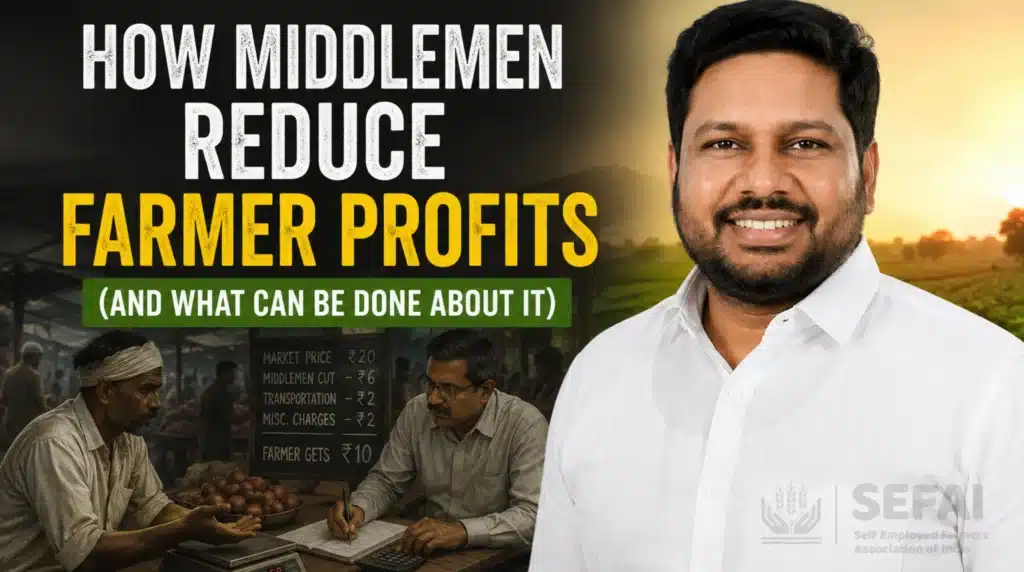
But because too many layers sit between the farmer and the final buyer.
By the time produce moves through traders, aggregators, transporters, wholesalers, distributors, and retailers, something interesting happens.
The price keeps increasing.
Yet the farmer’s share often stays surprisingly small.
The person who took the greatest risk frequently earns the smallest reward.
Think about that for a moment.
A farmer can lose an entire season to drought, floods, pests, disease, or market volatility.
The retailer selling the final product rarely carries those risks.
Yet it is often the farmer who has the least control over pricing.
That’s not just frustrating.
It’s economically damaging.
The conversation around agriculture often focuses heavily on production.
How can yields be improved?
How can farming become more efficient?
How can technology increase output?
Important questions.
But they miss a critical reality.
Higher production does not automatically mean higher income.
If market access remains weak, farmers can produce more and still earn less than they deserve.
It’s like filling a bucket with water while a hole at the bottom keeps getting bigger.
You work harder.
The result barely changes.
This is why fair price for farmers has become one of the most important conversations in modern agriculture.
The issue isn’t simply producing food.
The issue is ensuring that the people producing it receive a fair share of its value.
And fairness isn’t charity.
Fairness is sustainability.
If farmers consistently earn less than what their effort, investment, and risk justify, the entire agricultural system becomes fragile.
Eventually, fewer people want to stay in farming.
Rural economies weaken.
Food security becomes vulnerable.
Everyone loses.
The challenge becomes even bigger when farmers have limited access to market information.
Imagine entering a negotiation where the other side knows every price in the market and you know almost none.
That’s not negotiation.
That’s guesswork.
Many farmers sell quickly because crops are perishable, storage facilities are limited, and immediate cash needs cannot wait.
Middlemen understand this pressure.
And pressure rarely creates strong bargaining power.
This is why agricultural market access matters so much.
Access is not just about finding buyers.
It’s about creating options.
The more options a farmer has, the stronger their position becomes.
When farmers can connect directly with buyers, cooperatives, processors, institutions, exporters, or digital marketplaces, they gain something incredibly valuable.
Choice.
And choice changes everything.
Because when there is only one buyer, the buyer controls the price.
When there are multiple buyers, the market becomes more balanced.
Suddenly, the farmer has leverage.
Suddenly, value begins flowing closer to where it was created.
This is where organizations like SEFAI play an important role.
Many farmers don’t necessarily need another lecture about increasing productivity.
They already know how hard they work.
What they need is support in accessing markets, understanding pricing mechanisms, identifying better selling opportunities, and building stronger connections across the agricultural value chain.
Because income doesn’t improve simply by growing more.
Income improves when farmers can sell smarter.
When they receive reliable market information.
When they understand demand trends.
When they have access to better buyers.
When they are not forced into disadvantageous transactions simply because alternatives don’t exist.
That is real farmer income improvement.
Not temporary relief.
Not short-term fixes.
Sustainable improvement.
The future of agriculture is not only about producing more food.
It’s about ensuring farmers capture more value from the food they already produce.
Because the biggest problem isn’t always what happens in the field.
Sometimes it’s what happens after harvest.
Sometimes the difference between struggle and prosperity isn’t the crop itself.
It’s the market.
And when farmers gain better access to markets, fairer pricing, and stronger support systems, the entire equation changes.
The harvest finally starts rewarding the people who made it possible.
Which is exactly how it should have worked all along.