



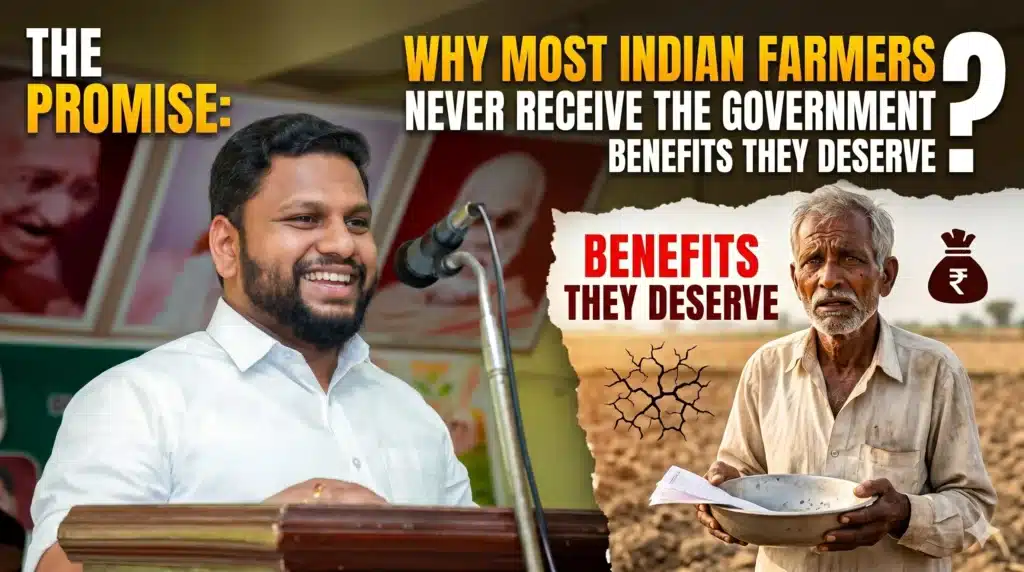
A few months ago, I was talking to a farmer who knew something most stock market analysts would be jealous of.
He knew exactly when rain was likely to arrive.
Not because he had an expensive weather app.
Not because he was following satellite reports.
He simply looked at the sky, touched the soil, and observed the wind.
Years of farming had trained him to notice details most people never see.
Then I asked him a simple question.
“Are you receiving all the government benefits you’re eligible for?”
He laughed.
Not because the question was funny.
Because he genuinely had no idea.
And that’s the problem nobody talks about.
Every year, new government schemes for farmers are announced. New subsidies appear. New support programs are launched. New budgets are allocated. Politicians make speeches. Headlines celebrate the announcements. Reports are published. Social media posts start flying around faster than cricket memes after an India-Pakistan match.
Yet millions of farmers still don’t receive the support they deserve.
The uncomfortable truth?
The problem isn’t that schemes don’t exist.
The problem is that many farmers don’t even know they exist.
Or worse.
They don’t know they’re eligible.
Think about how ridiculous that sounds.
Imagine winning a lottery and never being told you won.
The money exists.
Your name is on the list.
The prize belongs to you.
But nobody tells you where to collect it.
That’s exactly what happens with many farmer welfare schemes in India.
The support is available.
The awareness isn’t.
And awareness sounds like a boring word until you realize how expensive ignorance can be.
A farmer misses a subsidy.
A farmer misses crop insurance.
A farmer misses training opportunities.
A farmer misses financial assistance.
A farmer misses equipment support.
Individually these may seem like small misses.
Collectively they can change the future of an entire family.
The funny thing is that urban India often assumes farmers are disconnected from information because of technology.
That’s not entirely true.
Most farmers today have smartphones.
Many use WhatsApp daily.
Many watch YouTube.
Many follow news updates.
The problem isn’t access to information.
The problem is access to the right information.
There’s a huge difference.
I know people who can tell you every detail about a Bollywood celebrity’s wedding but have no idea how their health insurance works.
Information is everywhere.
Useful information is rare.
Farmers face the same challenge.
A government notification gets published somewhere.
An update is released.
Eligibility criteria change.
Application dates are announced.
Documents are required.
Corrections need to be made.
Now imagine trying to keep track of all that while also managing crops, labour, weather conditions, rising costs, market fluctuations, and the hundred other things farmers deal with every single day.
It’s like asking a pilot to fly the plane while simultaneously reading the instruction manual.
Something is going to get missed.
Take PM Kisan benefits as an example.
The objective behind the scheme is simple and powerful.
Provide direct financial support to eligible farmers.
That’s a good idea.
A very good one.
But here’s the question nobody asks enough.
How many eligible farmers fully understand the enrollment process?
How many know their application status?
How many know what to do if their records don’t match?
How many know how to solve documentation issues before payments get delayed?
Because a scheme isn’t successful when it’s announced.
It’s successful when money actually reaches the farmer.
There’s a massive difference between those two things.
That’s like saying you’ve built a bridge when you’ve only drawn it on paper.
The drawing looks impressive.
The river still isn’t crossed.
And this gap between availability and accessibility creates something even more dangerous than missed benefits.
It creates distrust.
After enough confusion, enough paperwork problems, enough missed opportunities, people stop believing the system works for them.
Human beings are surprisingly simple.
When something repeatedly feels difficult, we stop engaging with it.
You do it.
I do it.
Everyone does it.
That’s why nobody reads those 47-page software terms and conditions.
Life is already complicated enough.
Now imagine a farmer who has spent years hearing about schemes but struggling to access them.
Eventually he stops expecting help.
And that’s where the real damage begins.
Because once trust disappears, even genuinely useful programs lose their effectiveness.
This is why India doesn’t necessarily need hundreds of new schemes every year.
Sometimes India simply needs better visibility for the schemes already available.
Because let’s be honest.
A government scheme that nobody knows about is like hiding food from a hungry person and then congratulating yourself for cooking dinner.
The intention may be good.
The outcome is useless.
And this is exactly where SEFAI can make a meaningful difference.
Not by replacing government programs.
Not by creating another complicated layer.
But by becoming the bridge between farmers and opportunities they may never discover on their own.
Think about it.
Sometimes the most valuable thing you can give someone isn’t money.
It’s clarity.
A farmer doesn’t wake up every morning wondering which government portal he should visit.
He’s wondering whether rain will arrive on time.
Whether crop prices will hold.
Whether this season will be better than the last one.
If platforms like SEFAI can simplify information, explain eligibility, guide applications, and help farmers understand what support is available, something powerful happens.
The distance between policy and people starts shrinking.
And that’s where real impact lives.
Not in announcements.
Not in press conferences.
Not in reports.
But in the moment a farmer finally discovers a benefit that was meant for him all along.
Because at the end of the day, the biggest problem isn’t the lack of government schemes for farmers.
The biggest problem is that millions of farmers are standing one step away from support they deserve and don’t even know it’s there.
And solving that problem may help more farmers than launching another scheme ever could.