



For years, agriculture has been obsessed with one question:
“How do we grow more?”
So the answers kept looking the same.
Better seeds.
Better fertilizers.
Better irrigation systems.
Better machinery.
And yes, those things matter.
But here’s the uncomfortable truth nobody talks about enough:
A farmer can buy the best seeds in the district and still struggle.
Meanwhile, another farmer with similar land, similar weather, and similar resources quietly outperforms everyone around him.
Why?
Because agriculture has entered a different game.
And the winners of this game are not always the farmers with the biggest tractors.
They are often the farmers with the biggest understanding.
Knowledge has become the new competitive advantage in farming.
There was a time when farming was relatively predictable.
Your father taught you.
His father taught him.
The seasons followed familiar patterns.
The market moved slower.
The rules stayed mostly the same.
That world doesn’t exist anymore.
Weather behaves differently.
Consumer preferences shift constantly.
Technology evolves every year.
Government policies change.
Market prices move like they drank six cups of coffee before breakfast.
You are no longer competing against nature alone.
You are competing against complexity.
And complexity punishes people who stop learning.
Think about it this way.
If someone handed you the latest smartphone but never showed you how to use it, would you unlock its full potential?
Probably not.
You’d use maybe 20% of what it could actually do.
Modern agriculture works exactly the same way.
Many farmers have access to tools, schemes, technologies, and opportunities they never fully utilize because nobody showed them how.
The problem is rarely access.
The problem is understanding.
Let’s imagine two farmers.
Same village.
Same rainfall.
Same soil conditions.
Same seed variety.
At the end of the season, one earns significantly more.
What happened?
Most people immediately blame luck.
But farming success is rarely luck repeated year after year.
The difference usually comes from decisions.
When to sow.
When to irrigate.
How to manage pests.
Which crops to prioritize.
How to negotiate prices.
How to access government programs.
How to reduce waste.
How to protect soil health.
How to react when conditions change.
And every one of those decisions comes from knowledge.
The crop doesn’t make the decision.
The farmer does.
Which means the quality of the harvest often follows the quality of the thinking behind it.
That’s the part many people miss.
Here’s something fascinating.
A bag of fertilizer helps one season.
A lesson can help for twenty seasons.
Read that again.
One purchase creates temporary value.
One piece of knowledge can create permanent value.
That’s why farmer education has one of the highest returns on investment in agriculture.
When a farmer learns something useful, that knowledge compounds.
It keeps paying dividends.
Year after year.
Season after season.
Harvest after harvest.
It’s a bit like planting a mango tree.
You don’t get fruit once.
You keep getting fruit.
Knowledge works the same way.
Except it doesn’t care about droughts.
Let’s be brutally honest.
Many people still treat education as something children need.
Not something farmers need.
That’s a mistake.
A costly one.
Some people hear the phrase “farmer education” and immediately think someone is questioning farmers’ intelligence.
Nothing could be further from the truth.
Managing crops through uncertain weather, rising costs, labor shortages, and market volatility requires incredible intelligence.
Farmers are not lacking intelligence.
They’re often lacking access to updated information.
Big difference.
One is a capability problem.
The other is an opportunity problem.
And opportunity can be fixed.
There is an old story about a warrior who sharpened his sword every day.
His rival laughed.
“Why waste so much time sharpening?”
The warrior replied:
“Because battles change.”
Agriculture works exactly like that.
The techniques that worked twenty years ago may not work twenty years from now.
Not because previous generations were wrong.
Because conditions have changed.
And change doesn’t ask for permission.
It simply arrives.
Farmers who refuse to learn often discover this reality the hard way.
They become reactive instead of proactive.
They spend more time solving problems than preventing them.
And eventually, the gap between them and adaptable farmers becomes impossible to ignore.
The most successful farmers today share a surprising characteristic.
They are curious.
Not because they know less.
Because they know learning never ends.
They attend workshops.
They ask questions.
They experiment carefully.
They observe trends.
They learn from neighboring farmers.
They adopt useful innovations.
And perhaps most importantly…
They stay humble enough to admit they don’t know everything.
That mindset creates a massive advantage.
Because agriculture rewards adaptation.
Always has.
Always will.
The farmer who learns faster often grows faster.
Simple.
Not easy.
But simple.
Young people often avoid agriculture because they see it as outdated.
That’s unfortunate.
Because modern farming is becoming one of the most knowledge-driven industries in the world.
Today’s successful farmer needs skills that go far beyond planting and harvesting.
Business understanding.
Financial literacy.
Marketing knowledge.
Technology adoption.
Risk management.
Data interpretation.
Entrepreneurial thinking.
The future belongs to farmers who can blend traditional wisdom with modern knowledge.
Not one or the other.
Both.
Think of it like cricket.
A player who only relies on old techniques struggles against modern bowling strategies.
A player who ignores fundamentals struggles too.
The champions combine both.
Agriculture is no different.
Farmer education should not be treated as a one-time event.
It should become a habit.
A culture.
A mindset.
The goal isn’t replacing experience.
The goal is strengthening experience.
Every new insight gives farmers another tool.
Every new skill expands possibilities.
Every lesson creates options.
And options matter.
Because farming isn’t about controlling the future.
It’s about being prepared for it.
The more a farmer learns, the more prepared they become.
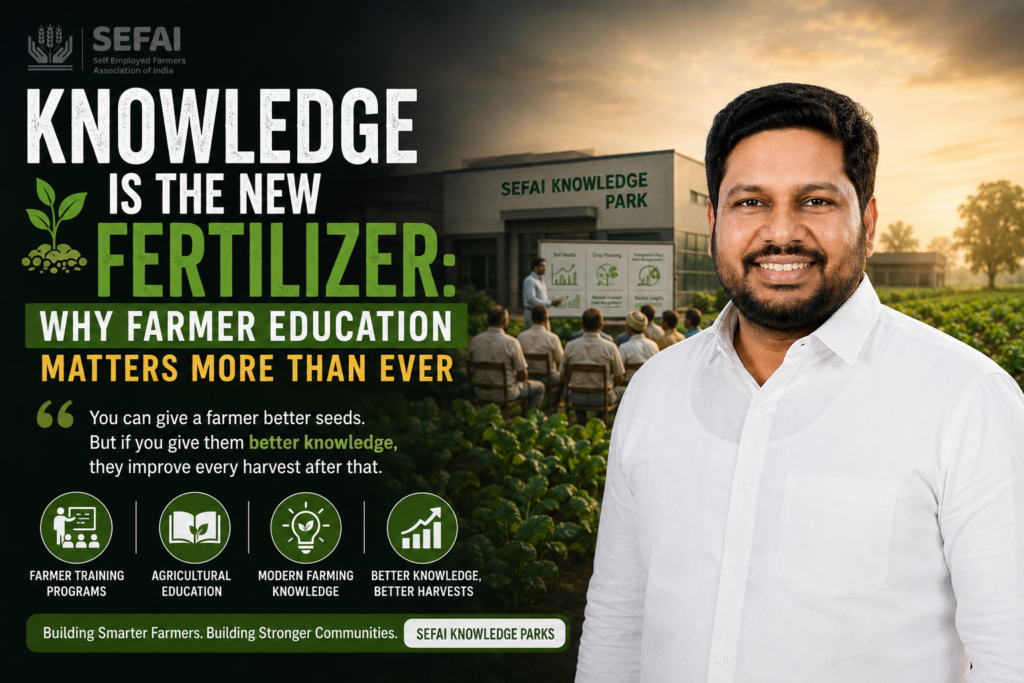
That’s why training initiatives, knowledge hubs, and agricultural learning programs have become increasingly important across modern farming ecosystems.
Most people still believe the future of farming will be shaped by better machines.
Or better seeds.
Or better technology.
Those things will help.
Absolutely.
But they are not the real game-changer.
The real game-changer sits between a farmer’s ears.
Knowledge.
Because land has limits.
Machinery has limits.
Resources have limits.
Learning does not.
The farmer who keeps learning gains an advantage that competitors cannot easily copy.
And in a world where agriculture becomes more complex every year, that advantage might become the most valuable asset on the entire farm.
Seeds grow crops.
Knowledge grows possibilities.
And the farmers who understand that today will be the ones leading agriculture tomorrow.